RBI ECL staging for every facility on your loan tape
Stage 1, 2 or 3 for every facility, with the reason, the provision against the RBI floor, and the report for your Board.
Three dates for every Indian bank
31 March 2027
The transition amount
ECL required on 1 April 2027, computed on the 31 March balance sheet, less the IRACP provision held that day. Up to 4/5 of it, net of tax, can be added back to CET1 in 2027-28, down to 1/5 in 2030-31.
RBI ECL Directions, paras 107 and 108
1 April 2027
ECL takes effect
The Directions come into force for commercial banks. From this date, each loan is in Stage 1, 2 or 3 at every reporting date.
RBI ECL Directions, paras 2, 4 and 25
30 June 2027
The first ECL reporting
The first reporting under the ECL framework is based on the financial position as on this date.
RBI ECL Directions, para 147
Days past due is the backstop, not the test
Reasonable and supportable information
At each reporting date, compare the risk of default over the expected life now with the risk at initial recognition.
RBI ECL Directions, para 26
Overdue status is the backstop
Days past due may be used when more forward-looking information is unavailable. More than 30 days is a rebuttable presumption.
RBI ECL Directions, paras 28 and 33
Documented, consistent criteria
The Stage 2 criteria are written down and applied the same way every time, such as the number of rating notches that counts as a downgrade.
RBI ECL Directions, paras 29 and 30
Scroll sideways to see the whole screen.
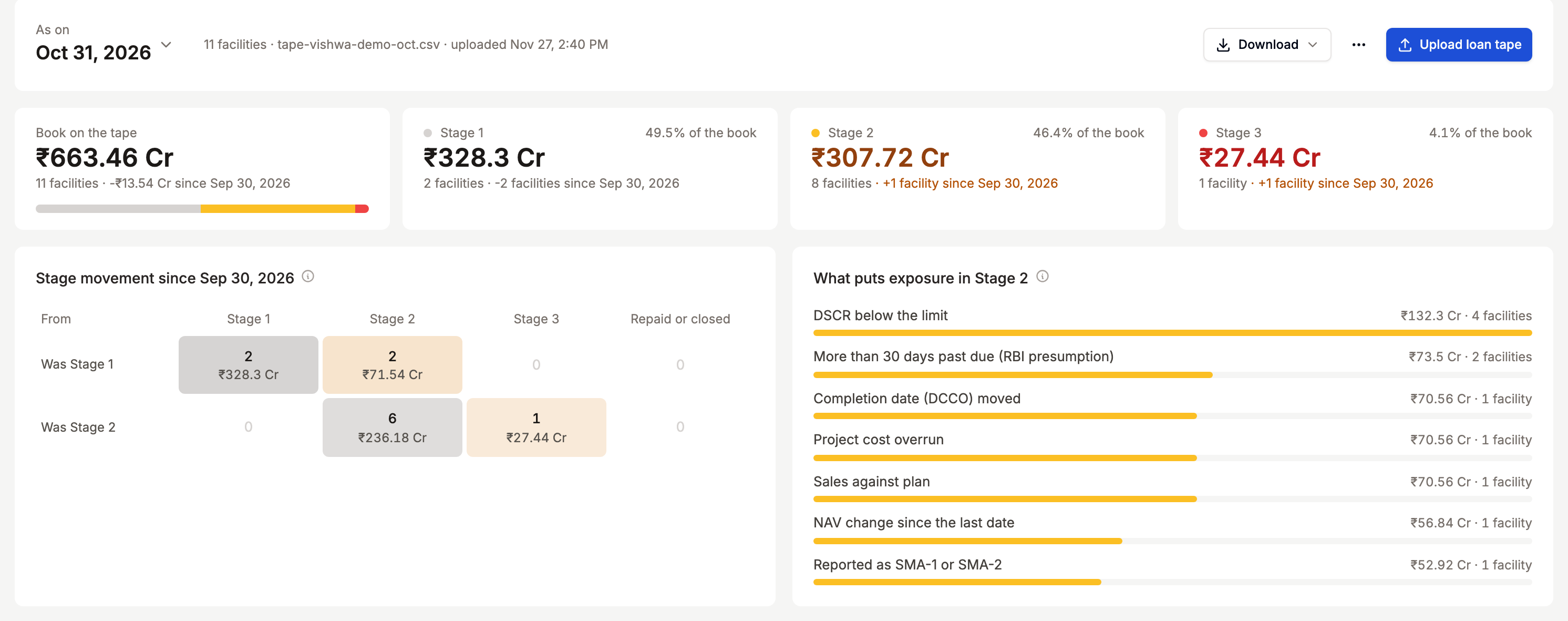
From loan tape to Board report
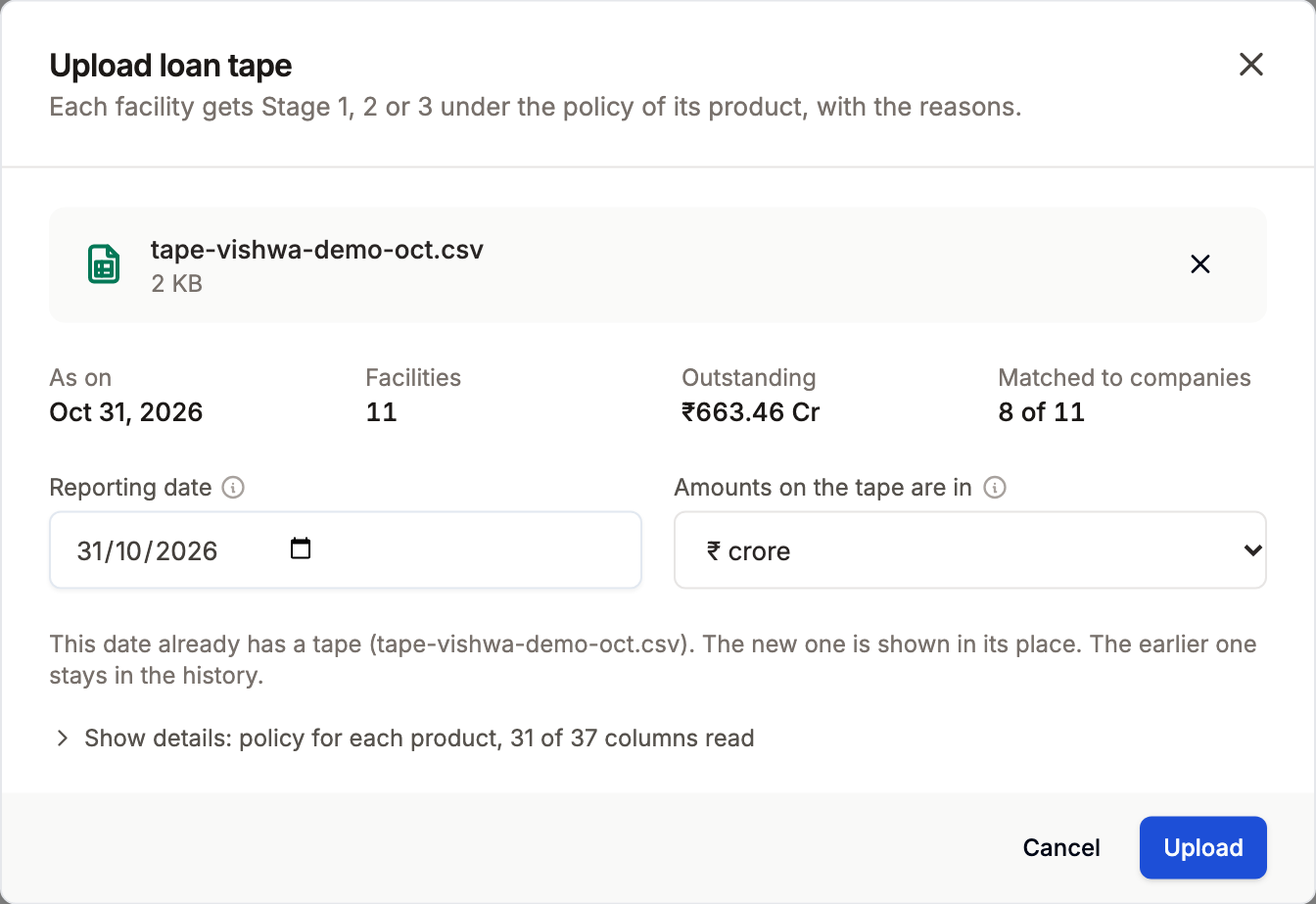
- 1
Upload the loan tape
A CSV or XLSX from your loan system. Before staging, a check shows the columns read, the borrowers matched, the reporting date, and the unit.
- 2
Apply your Stage 2 policy
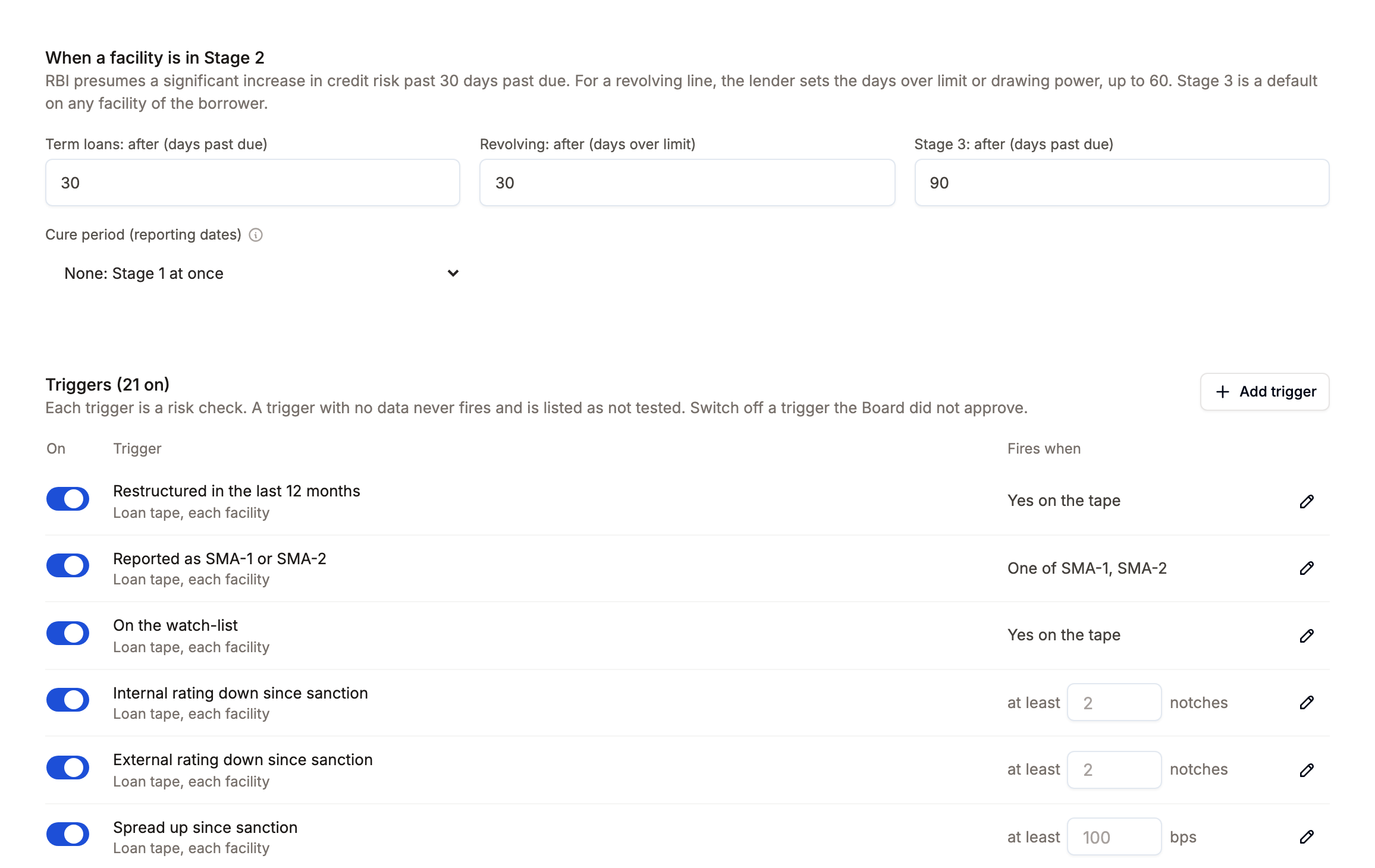
One policy for each product. Each trigger is a risk check with its own limit, set to your Board-approved values.
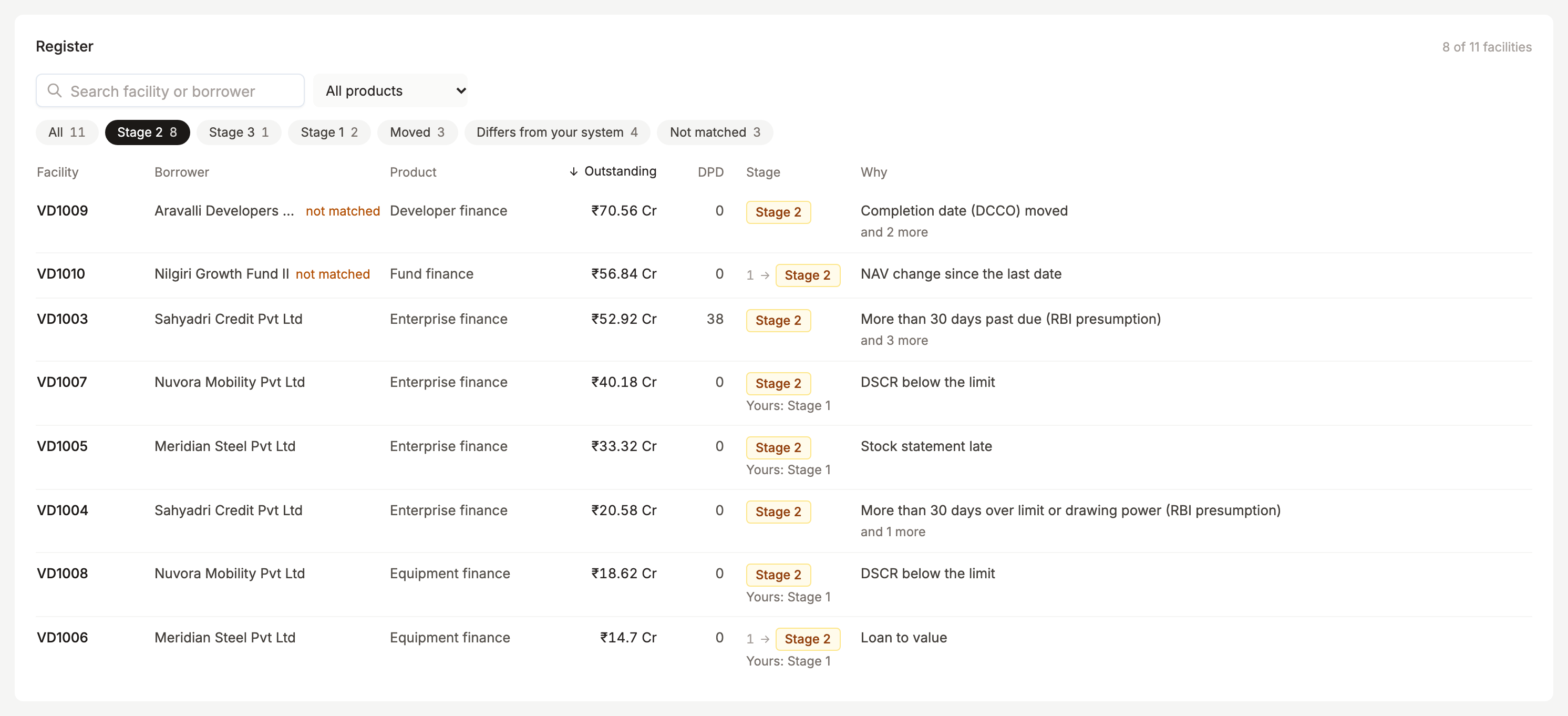
- 3
Read the register
Every facility gets its stage and the triggers that put it there, with the value and the limit.
- 4
Compute the provision
PD × LGD × EAD for each facility, compared with the RBI floor for its loan category, plus the add-ons.
- 5
Send the report
A PDF for the Board, and an XLSX register with every part of the provision for each facility.
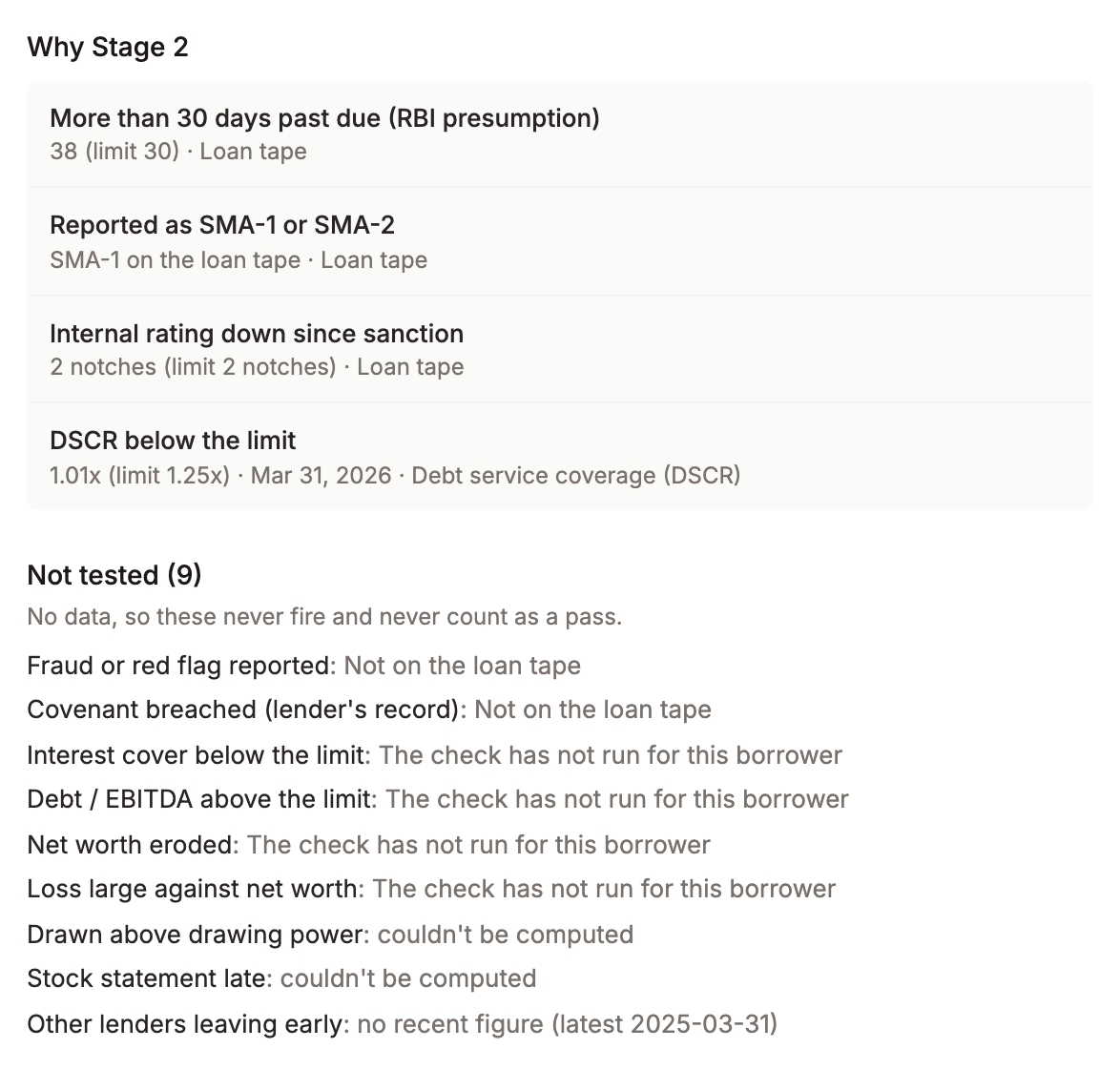
The reason for every Stage 2
- A check with no data is listed as not tested. It is never counted as a pass.
- When one facility of a borrower is in Stage 3, all of the borrower's facilities follow.
- An override needs a reason and a named approver, and it expires. Stage 3 cannot be overridden.
- Your own stage from the tape is shown beside ours, so every difference is visible.
RBI ECL Directions, paras 34, 35, 36 and 76
Your policy, your limits
- Each trigger is a risk check with its own limit: days past due, days over limit, rating notches down, DSCR, LTV, NAV fall, DCCO delay, cost overrun and others.
- Triggers read the tape, and also vishwa.ai's own risk checks on the borrower's financials and public records.
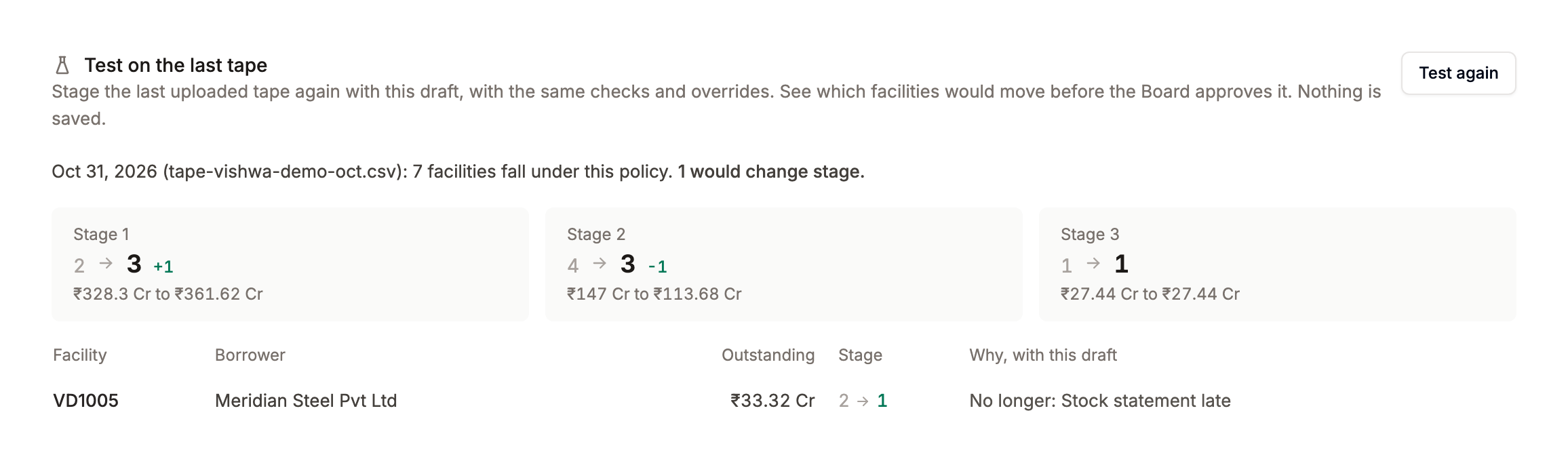
- Test this draft on your last tape before the Board approves it. Each run stamps the policy it used, so a later change to any limit shows on the record.
Scroll sideways to see the whole screen.
Scroll sideways to see the whole screen.
RBI ECL Directions, paras 29, 30 and 35
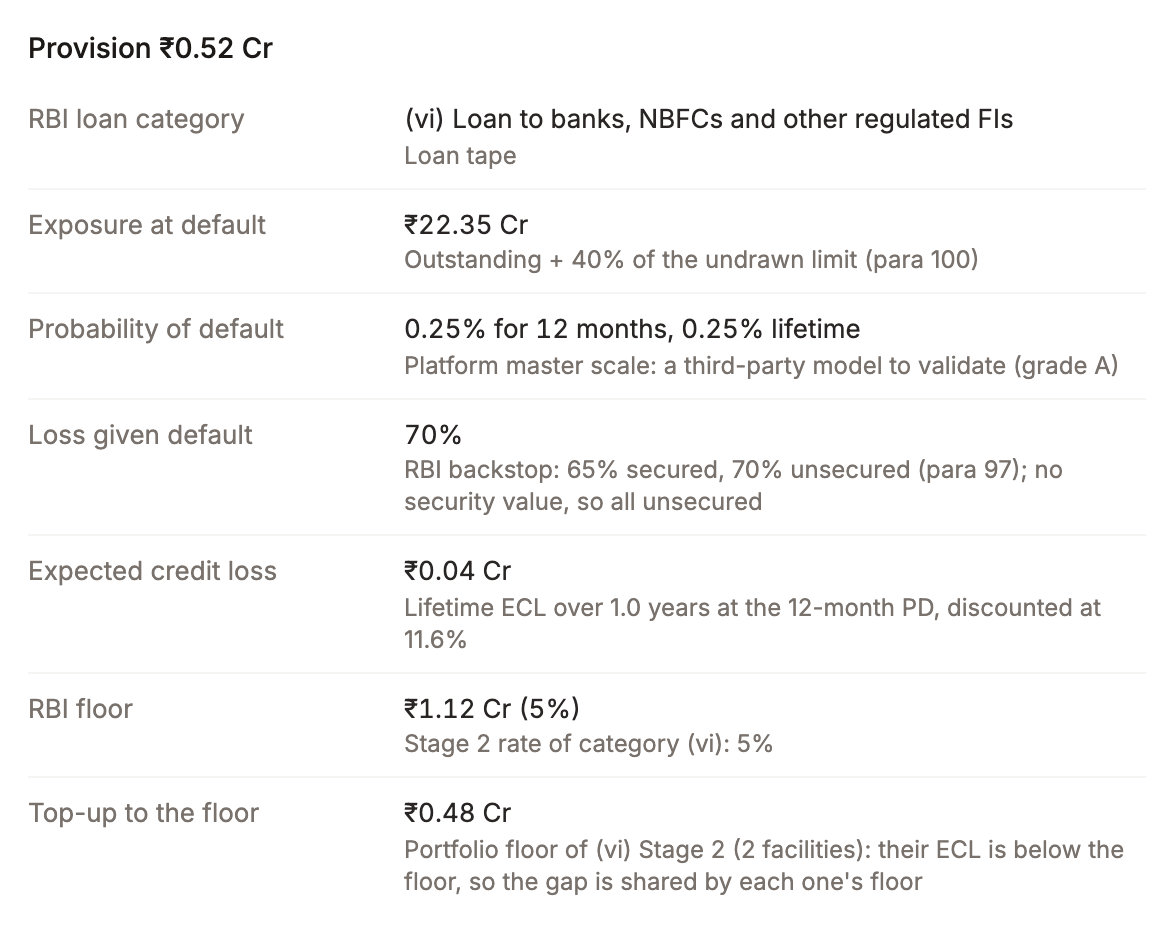
The provision, against the RBI floor
- Your own PD and LGD tables come first. Without them, the platform's values are labelled as a third-party model for you to validate.
- Floors for Stage 1 and Stage 2 apply to the portfolio of each category. Stage 3 floors apply to each account.
- Add-ons for DCCO deferment, wilful defaulters and fraud are added on top.
RBI ECL Directions, paras 82, 90, 96 to 98, 101, 135 and 136
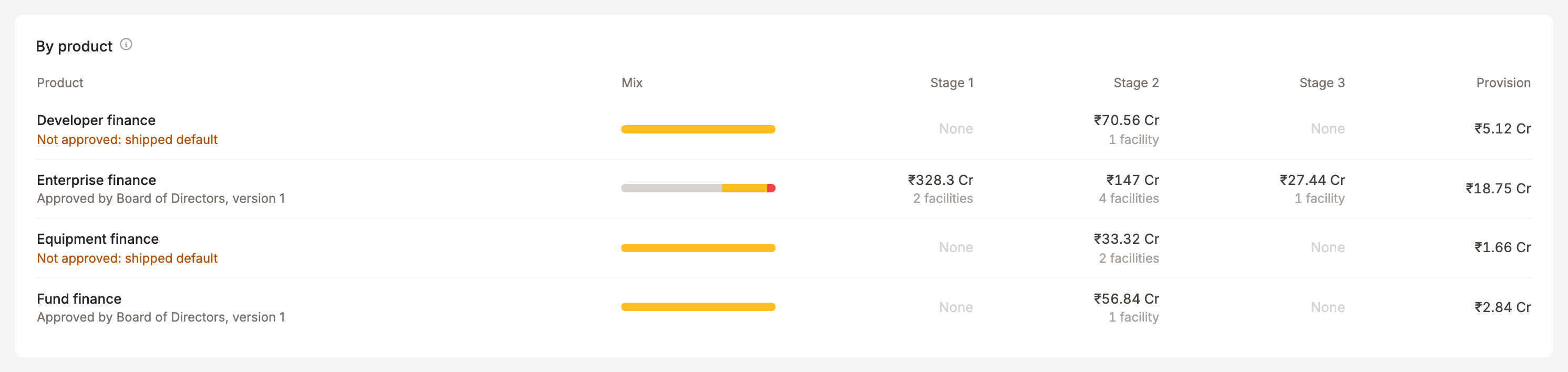
The book by product
Scroll sideways to see the whole screen.
The report for your Board
- The summary by stage, the movement since the last reporting date, and the triggers behind Stage 2.
- The provision by loan product category and stage, with the floor, the top-up and the add-ons.
- On 31 March 2027, the report adds the transition amount and the CET1 add-back for each year.
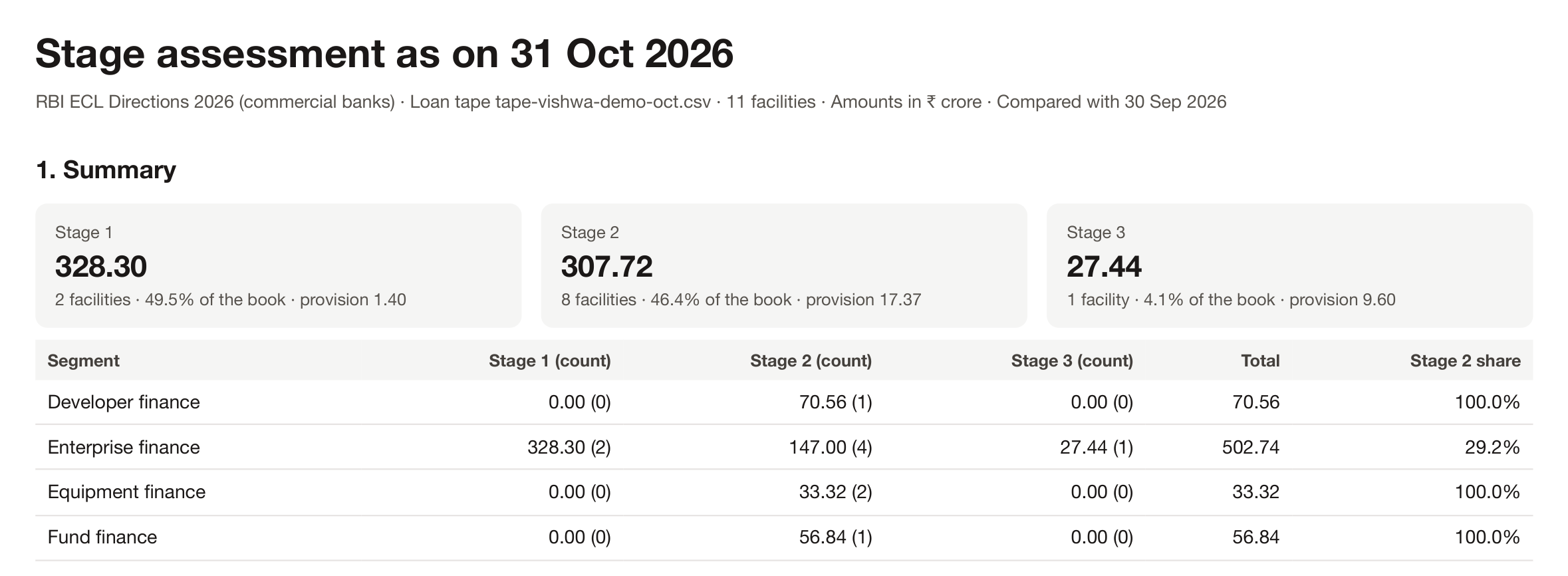
Scroll sideways to see the whole screen.
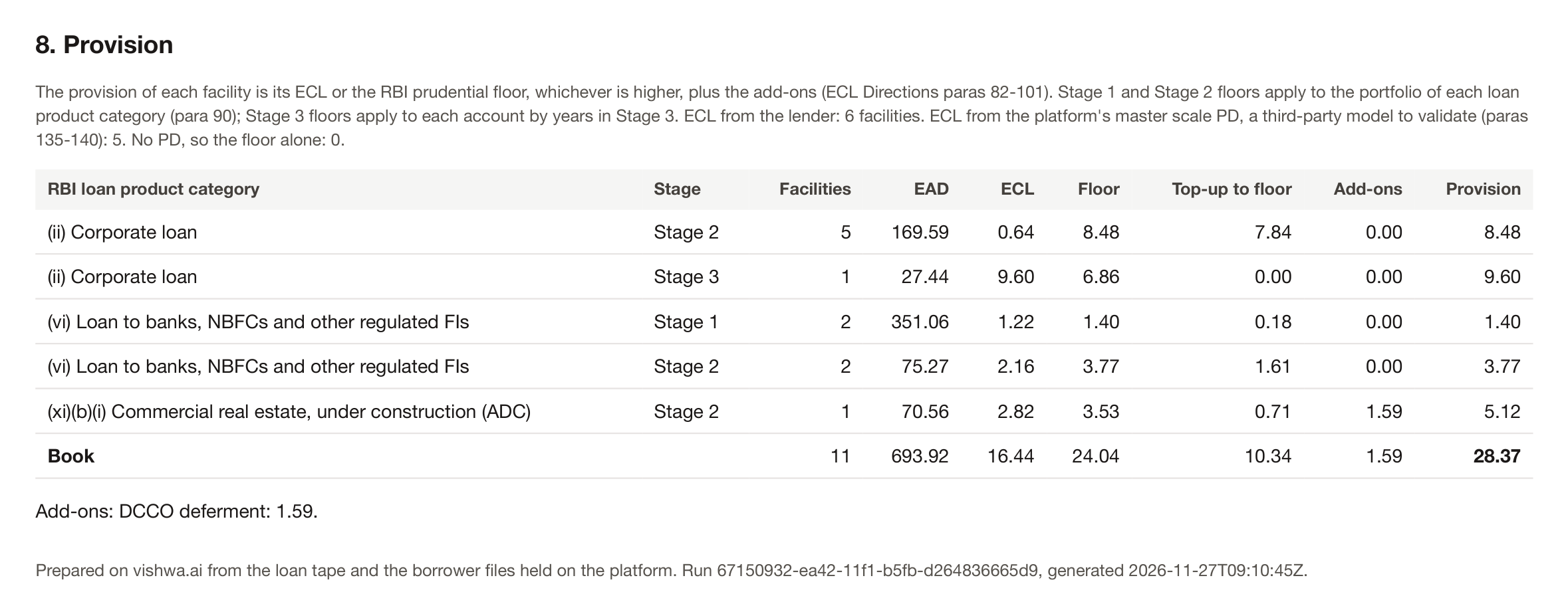
Scroll sideways to see the whole screen.
RBI ECL Directions, paras 107 and 108
For NBFCs on Ind AS 109
The same engine stages an NBFC's book under Ind AS 109. The report adds the comparison the RBI asks for in its circular of 13 March 2020: your Ind AS 109 allowance against the IRACP provision, and the difference that goes to the Impairment Reserve when the allowance is lower.
Frequently asked questions
Still deciding? Talk to our team.
When do the RBI ECL Directions take effect?
On 1 April 2027 (para 2). The first reporting under the ECL framework is based on the financial position as on 30 June 2027 (para 147). The transition amount is the ECL required on 1 April 2027, computed on the 31 March 2027 balance sheet, less the IRACP provision held on 31 March 2027 (para 107).
Which lenders do the Directions apply to?
Commercial banks. Small finance banks, payments banks and local area banks are outside the definition (para 4). NBFCs on Ind AS follow Ind AS 109 and the RBI circular of 13 March 2020. vishwa.ai runs the same staging engine for them, with the comparison table that circular asks for.
Is days past due enough to stage a loan?
Days past due is the backstop. A bank must consider reasonable and supportable information on the risk of default (para 26), and may use overdue status when more forward-looking information is unavailable (para 28). More than 30 days past due is a rebuttable presumption of a significant increase in credit risk (para 33). vishwa.ai adds triggers such as rating notches down, DSCR, LTV, NAV fall, DCCO delay and cost overrun, set for each product in your policy.
How does vishwa.ai treat revolving facilities?
For revolving facilities, the presumption is tied to a balance continuously above the sanctioned limit or drawing power, whichever is lower (para 33). vishwa.ai reads days over limit from the tape, and the number of days that moves a line to Stage 2 is a limit on your policy.
Can we rebut the 30 days past due presumption?
Yes, with reasonable and supportable information (para 34), under a policy approved by the Board or a Board-approved committee (para 35), and with documents for each instance (para 36). In vishwa.ai, an override needs a reason and a named approver, it has an expiry date, and it stays on the record. Stage 3 cannot be overridden.
How is the provision computed?
ECL is PD × LGD × EAD for each facility, over 12 months in Stage 1 and over the lifetime in Stage 2 (para 18). The 12-month PD has a floor of 0.03% (para 96). The result is compared with the prudential floor for the loan product category (para 82): on a portfolio basis for Stage 1 and Stage 2 in each category, and for each account in Stage 3 (para 90). Add-ons cover DCCO deferment (para 82), fraud (para 101(2)) and wilful defaulters (para 101(4)).
Is the vishwa.ai PD a validated model?
No. Your own PD and LGD tables come first. Without them, vishwa.ai uses its rating engine's PD for each grade and the regulatory backstop LGD (paras 97 and 98), and labels them as a third-party model for you to validate. The bank stays responsible for third-party models (paras 135 and 136).
Is a whole borrower moved to Stage 3?
Yes. When any exposure to a borrower is in Stage 3, all exposures to that borrower are classified as Stage 3. Stage 2 applies at the facility level (para 76).
Sources: Reserve Bank of India (Commercial Banks - Asset Classification, Provisioning and Income Recognition) Directions, 2026, RBI/DOR/2026-27/398, 27 April 2026. Implementation of Indian Accounting Standards, RBI/2019-20/170, 13 March 2020. Paragraph numbers on this page refer to the 2026 Directions. The screenshots use a demo loan tape with fictional borrowers.

Stage your book before 1 April 2027
Send us a loan tape. We will show you the register, the reasons, and the provision against the RBI floor.