Meet SoDEX: the successor to DEX, and a new way people and machines reach numbers you can sign off on
DEX is our AI agent for extracting financial documents. It takes the documents private credit runs on (annual reports, audited accounts, rent rolls, bank statements, often scanned or handwritten) and extracts every number into a lender’s spread. Like everyone building these systems, we measured it by accuracy. We improved the model and the agent harness around it, covered more scenarios, and chased even the edge cases. On our documents, it outperformed general-purpose frontier models.
But in private credit, a number that is probably right can’t go into a credit memo. A trained reviewer still checks every figure against the source before sign-off. That audit is where the time goes. No accuracy benchmark measures it, and nobody puts it in a demo.
So we built SoDEX (“Son of DEX”) around a different target: the review time it takes to reach 100% accuracy. Instead of trying to be silently right, SoDEX tells the reviewer exactly which few lines need a closer look. In side-by-side tests on the same documents, with the same reviewers, review time dropped by 60 to 67%.
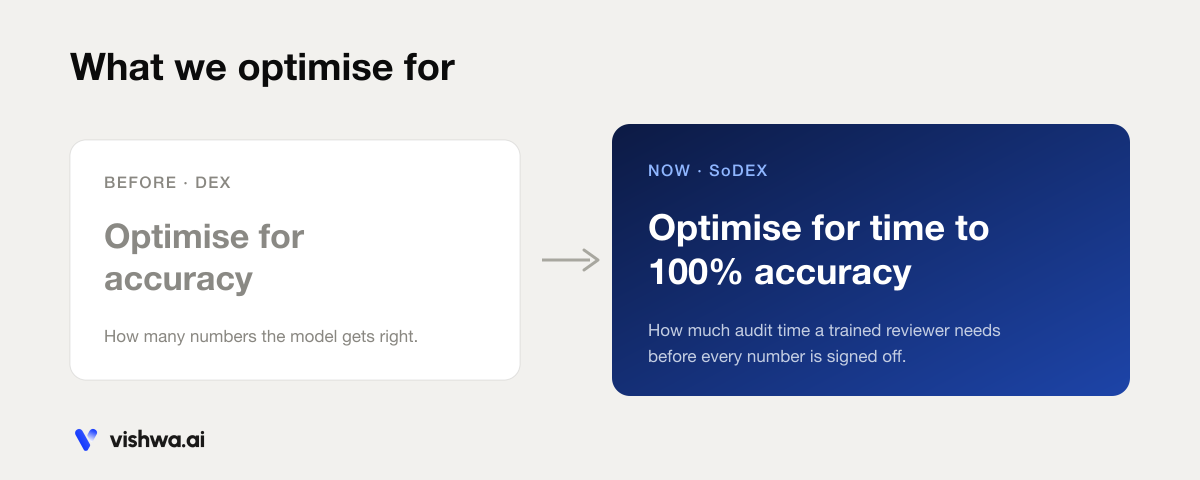
DEX’s later versions already moved this way. SoDEX is the step jump, and it holds up across the scenarios we deal with. We didn’t spend much time on the name (you’ll find out why by the end). It is quicker to work with than its parent, and a little better behaved, to say the least.
Built for messy documents, and clear about what it cannot confirm
SoDEX is a very different kind of Agentic Harness than what everyone is used to.
It still leverages the auto-learning framework we already established with DEX, and also takes a clear step further to leverage human intelligence in more optimized way. The framework is made for the messy, scanned documents that private credit runs on, whatever form they arrive in. Being built for exactly this helps in two ways.
The first is cost. It runs at five to eight times less than a frontier model and our specialized harness is what makes this possible. When a team is working through hundreds of files, that is the difference between using it on the important ones and using it on all of them.
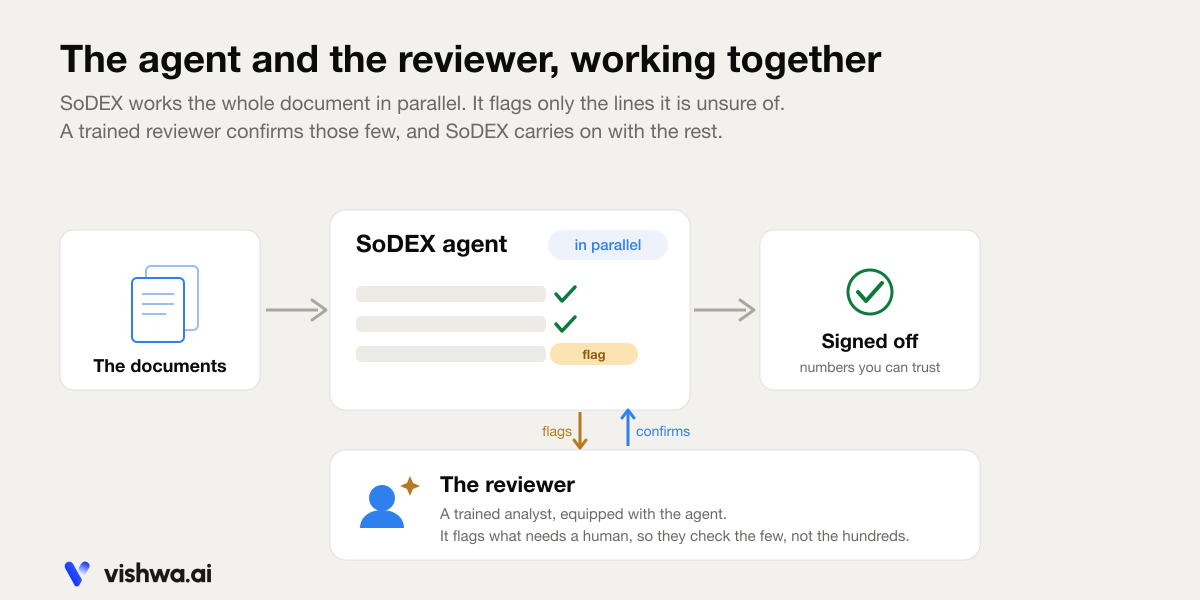
The second one matters more to us. SoDEX knows when it is not sure. A frontier model gives you an answer with the same confidence whether it is right or wrong. SoDEX gives you the answer and flags the parts it is unsure about, then keeps working while a trained reviewer confirms those few. The reviewer does not have to search the whole document for the one mistake. SoDEX has already found it.
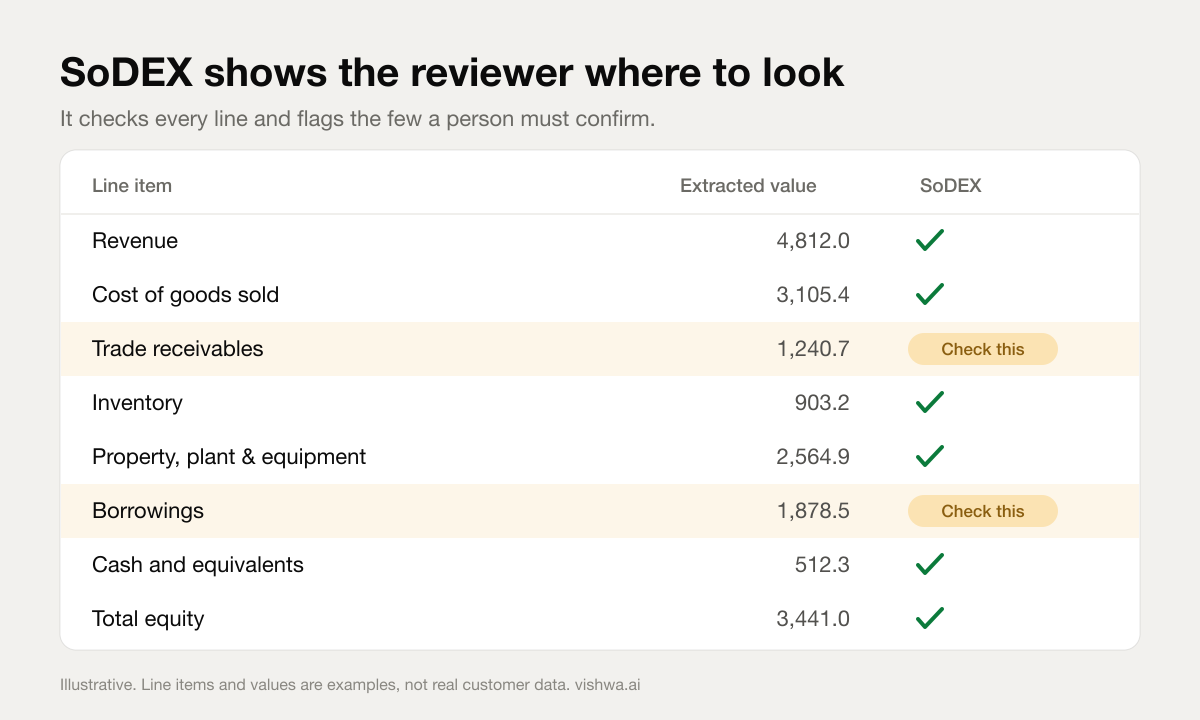
A trained reviewer’s time is valuable. We would rather use it on the few numbers that need a closer look than on the hundreds that do not.
That is the whole idea. Not a person fixing a spreadsheet by hand. A trained reviewer and a specialized agent on the same document. The agent works in parallel, flags the few lines it is unsure of, and the reviewer confirms them.
What we saw
Auditing needs a human. Every number in a credit memo has to trace back to its source. A missed covenant or a mismatch has to show up before the file is approved, not weeks later by accident. That is what the reviewer is protecting. It is slow because it is careful, and careful is the point.
When the agent flags exactly what to check, the careful part gets faster without getting sloppy. We ran SoDEX and DEX on the same documents. Same pages, same scans, nothing set up to make the new one look good. Then we timed how long a reviewer needed to take each document to 100% accuracy.
That time dropped by 60 to 67%.
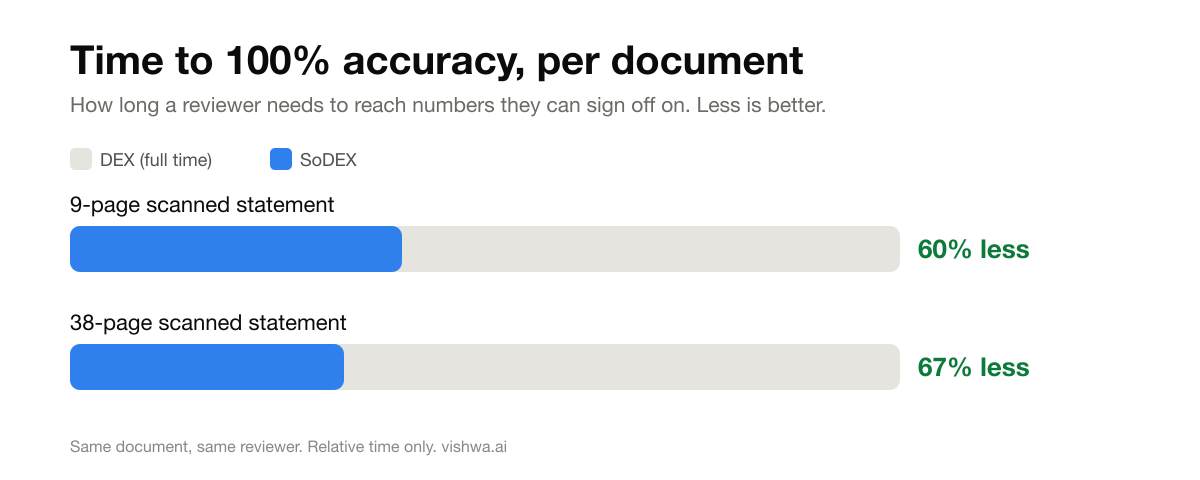
Same document. Same reviewer. A fraction of the time, and a number they could sign off on at the end.
The metric that matters
Cut the review time on a document by 60% or more, and the same team gets through far more in a day. Not by hiring. Not by working later. The reviewer spends their time where it counts and skips the rest.
Accuracy scores tell you how good a model is. They don’t tell you how long your team spends before a number can go into a credit memo. In private credit, that is the number that decides how many deals you close. We think every AI vendor selling into credit should be asked one question: how long until my reviewer signs off?
In summary
- Where DEX was already accurate, SoDEX matched it and left the reviewer less to fix.
- Where DEX struggled, SoDEX was clearly more accurate.
- Reviewers reached 100% accuracy in 60 to 67% less time, so the same team signs off on more files.
At the time of writing this, we’re already well into the next model. The early read from internal pilots is another step jump. I’ll share once we’ve established that too.